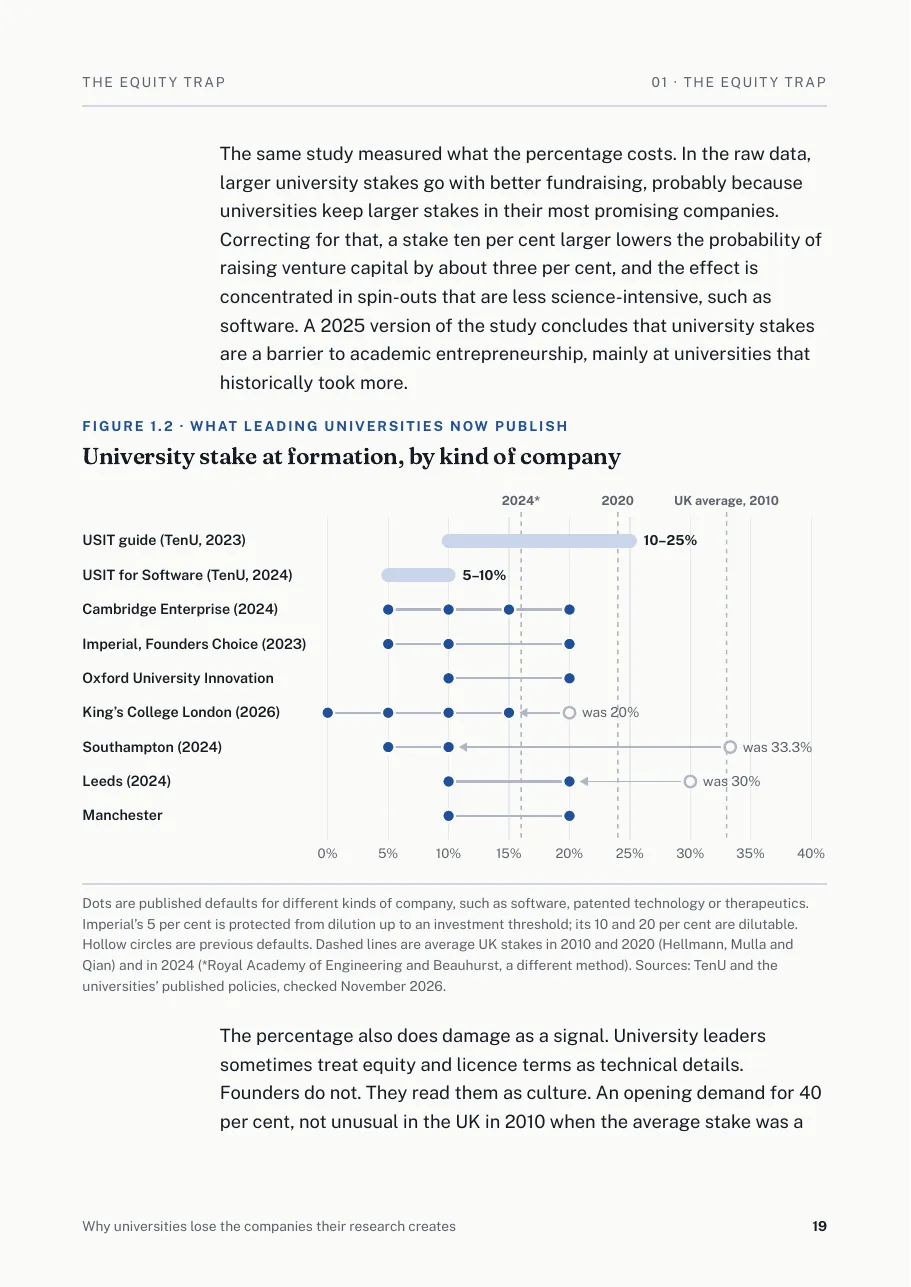
24%
average university stake in UK spin-outs in 2020, down from 33 per cent in 2010
Section 01
Paper IV · Second edition · A discussion series for ecosystem builders
Why universities lose the companies their research creates, and what to build instead.
The argument
A university’s claim on a spin-out has four parts: control, cash before revenue, time and the percentage. This paper ranks them, shows where universities lose the companies their research and their students could create, and sets out seven moves, held together as one layer across the institution.
8Sections in two parts: the diagnosis and the rebuild
7Moves for a university that founders do not need to escape
10Named institutions, with their own figures
Summary
Universities have built large portfolios of entrepreneurship and commercialisation activity, much of it optimised for institutional legibility rather than founder outcomes. Technology-transfer offices count disclosures, patents and licences; entrepreneurship centres count events and incubator places. The founder’s experience stays slow and fragmented.
The core argument is deliberately counterintuitive: universities should take less from individual companies in order to create more valuable companies overall. This is not generosity. It is portfolio logic. A university that maximises its starting claim on a fragile spin-out lowers the probability that the company is founded, funded or able to recruit. One that takes a smaller, clearer position, and decides quickly, raises the odds that the company exists, hires graduates and stays connected to the institution.
Inside the paper
What is inside
Why technology transfer optimised for the wrong outcome, and which of a university’s claims on a spin-out does the most harm.
Why entrepreneurship programmes graduate students who do not start companies.
How universities lost the relationship between research and enterprise, and how to rebuild it before the contract.
Why university start-up support cannot serve the companies that grow, and what it should offer them instead.
Why universities train the best technical founders and then discourage them from founding.
Why founder alumni are treated as donors rather than strategic partners.
Seven moves for a university that founders do not need to escape.
The delivery model for the seven moves: one cross-campus layer, present from a student’s first day and owned at the top of the institution.
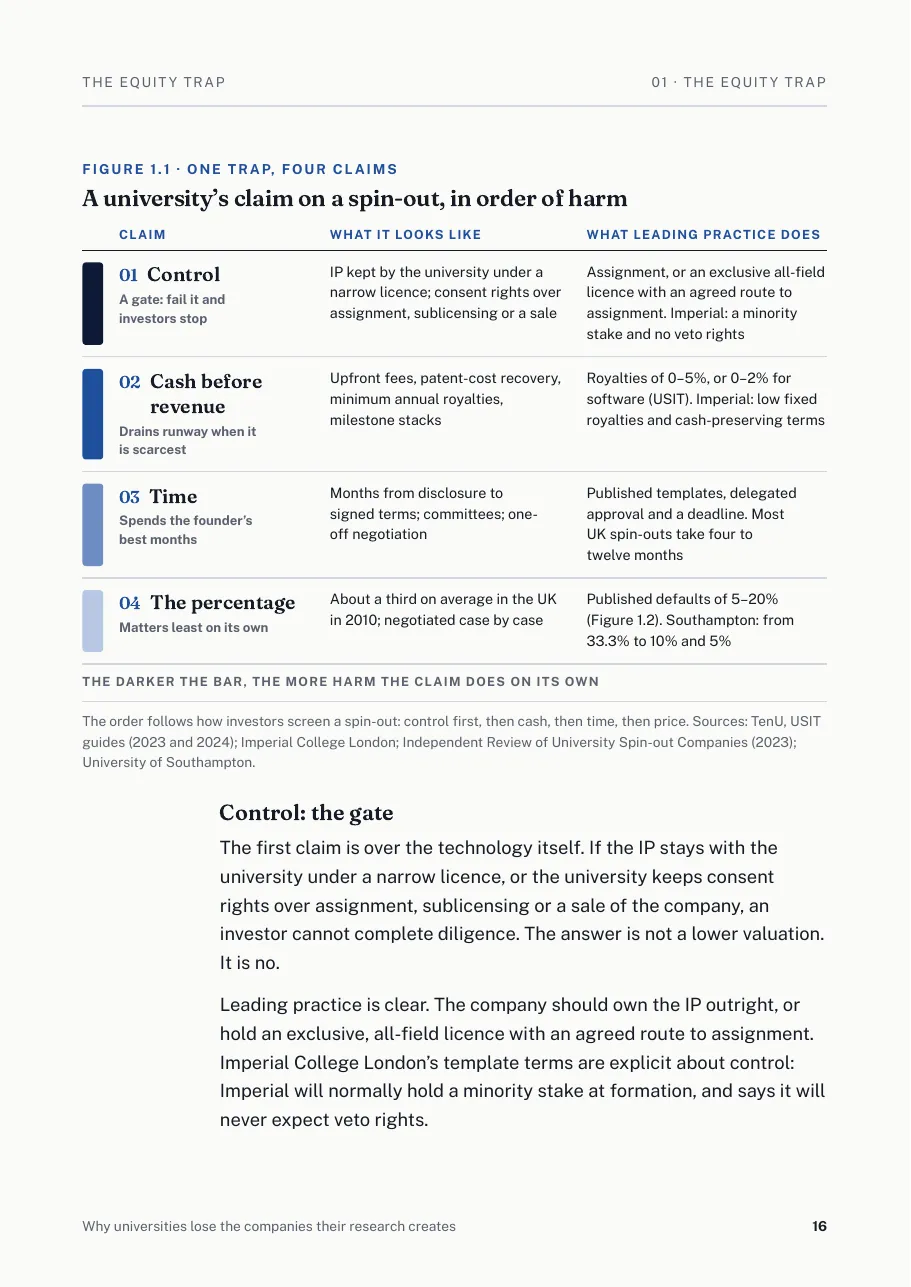
One trap, four claims
The claim a university makes on a spin-out has four parts, and they do not do equal harm.
Control decides whether investors can invest at all.
Cash taken before revenue, in fees, minimum royalties and milestone payments, drains runway when the company has least of it.
Time spends the founder’s best months on negotiation.
The percentage, the part universities argue about most, does the least harm on its own.
At a glance
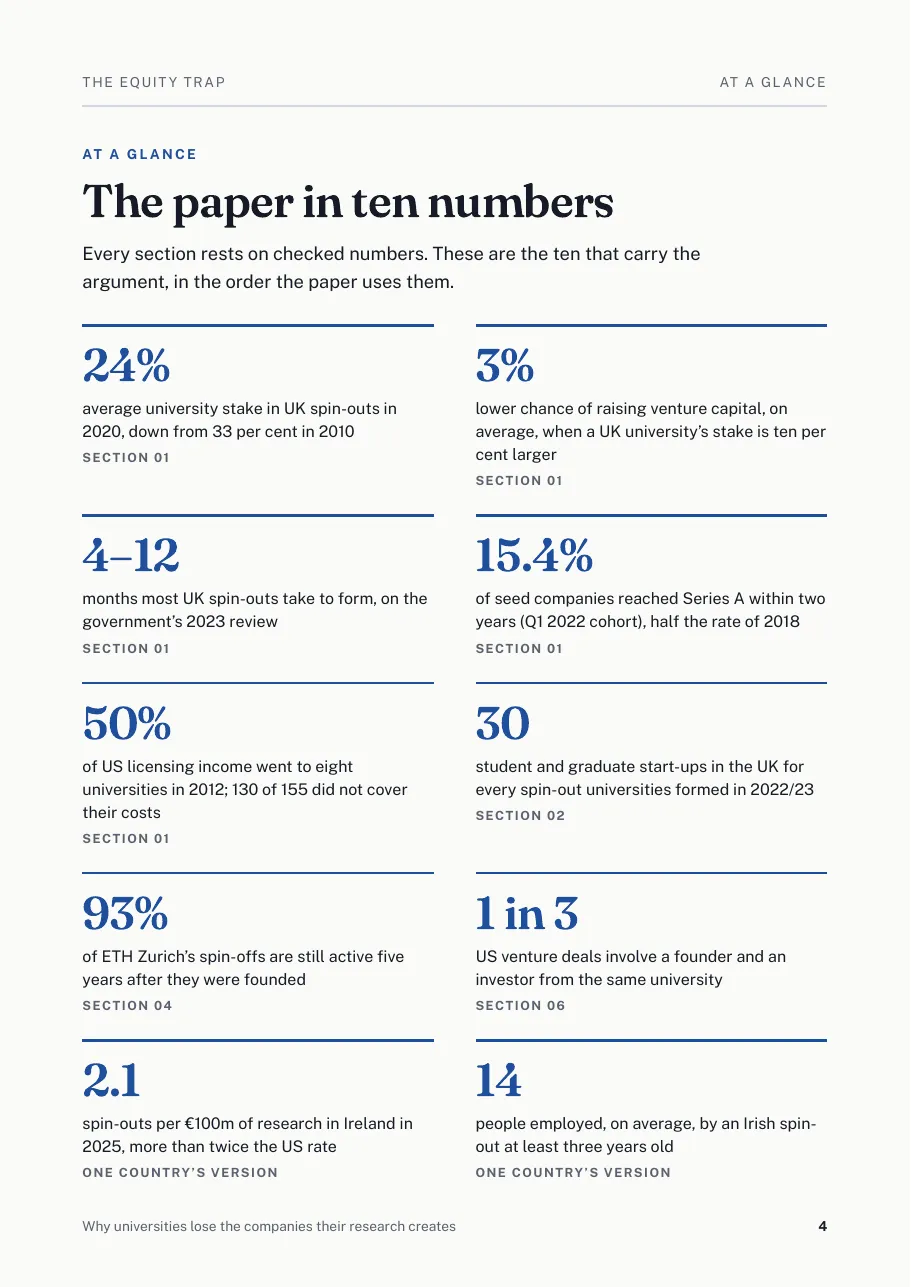
Every section rests on checked numbers. These are the ten that carry the argument, in the order the paper uses them. The source for each is given in the section named.
24%
average university stake in UK spin-outs in 2020, down from 33 per cent in 2010
Section 01
3%
lower chance of raising venture capital, on average, when a UK university’s stake is ten per cent larger
Section 01
4–12
months most UK spin-outs take to form, on the government’s 2023 review
Section 01
15.4%
of seed companies reached Series A within two years (Q1 2022 cohort), half the rate of 2018
Section 01
50%
of US licensing income went to eight universities in 2012; 130 of 155 did not cover their costs
Section 01
30
student and graduate start-ups in the UK for every spin-out universities formed in 2022/23
Section 02
93%
of ETH Zurich’s spin-offs are still active five years after they were founded
Section 04
1 in 3
US venture deals involve a founder and an investor from the same university
Section 06
2.1
spin-outs per €100m of research in Ireland in 2025, more than twice the US rate
One country’s version
14
people employed, on average, by an Irish spin-out at least three years old
One country’s version
The rebuild
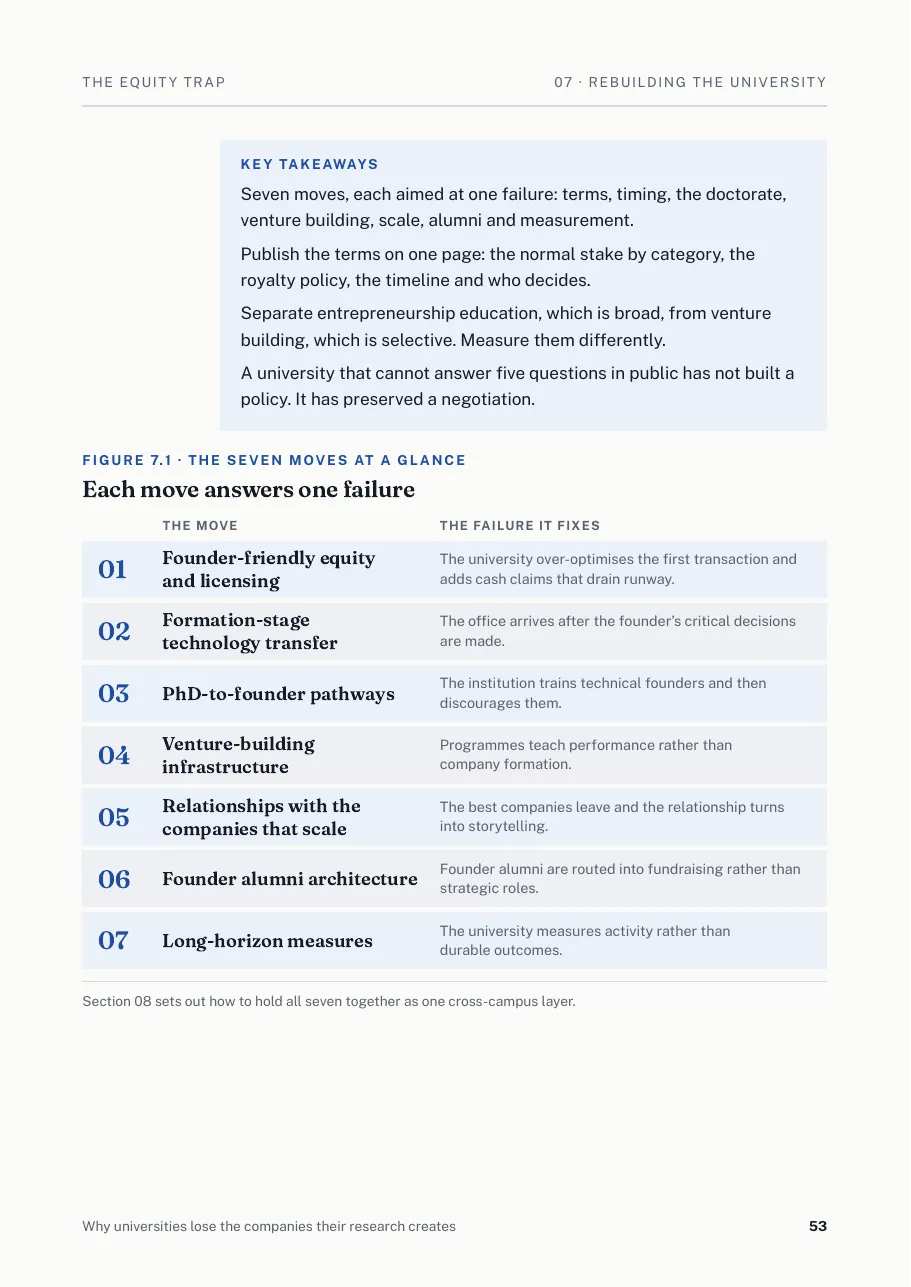
Terms, timing, the doctorate, venture building, scale, alumni and measurement.
The university over-optimises the first transaction and adds cash claims that drain runway.
The office arrives after the founder’s critical decisions are made.
The institution trains technical founders and then discourages them.
Programmes teach performance rather than company formation.
The best companies leave and the relationship turns into storytelling.
Founder alumni are routed into fundraising rather than strategic roles.
The university measures activity rather than durable outcomes.
How to use this paper
Those responsible for research, enterprise, entrepreneurship, commercialisation, alumni and institutional strategy, and the investors and governments who work with them.
The executive summary, Sections 01, 07 and 08, and the conclusion.
Sections 01, 03, 05 and 07.
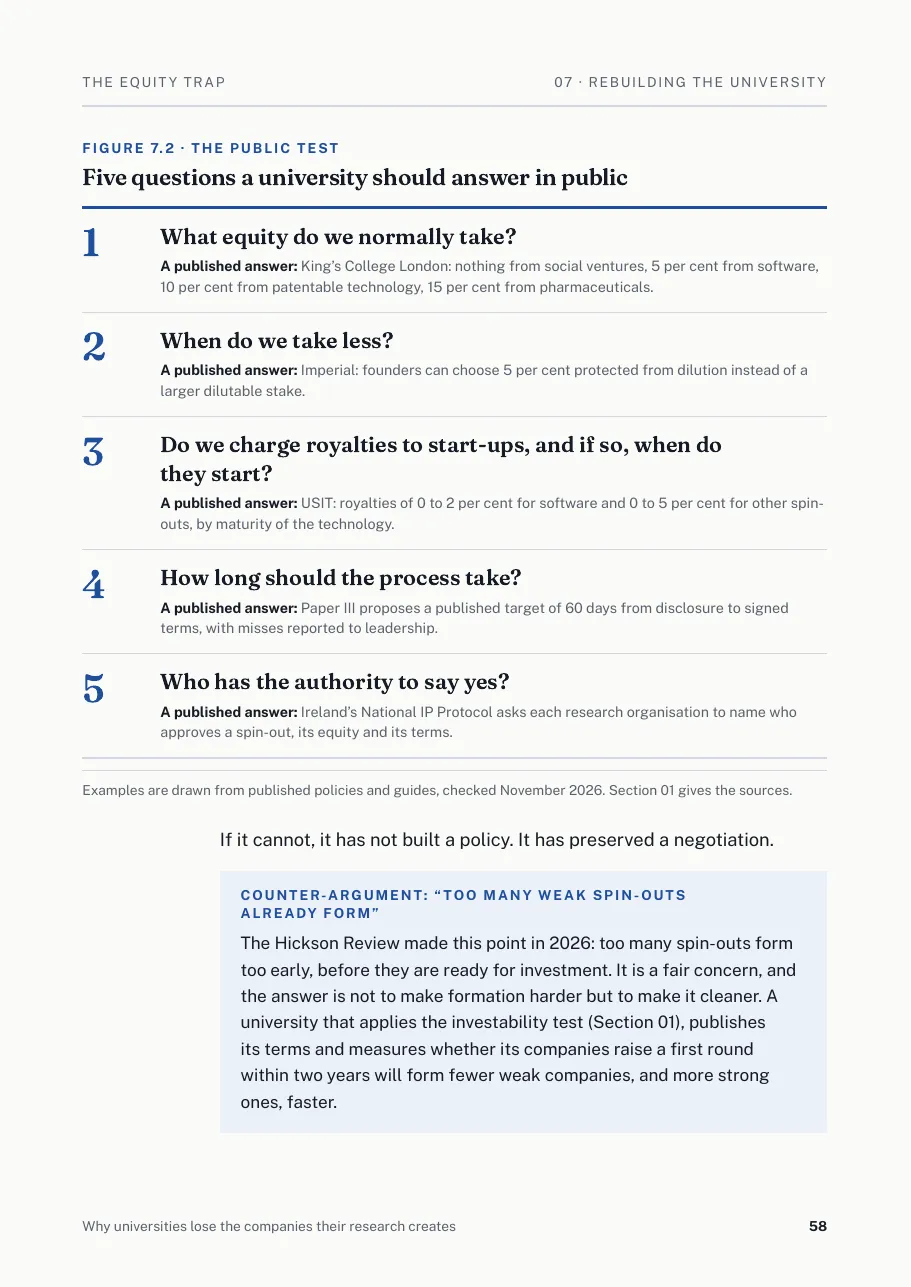
Section 01 in full, then the five questions in Section 07.
Sections 02, 04, 06 and 08.
Sections 01 and 04, one country’s version, and where this lands.
From the paper
The university that takes less when a company is fragile creates more companies, more jobs, more research and, in the end, more institutional value.
The founders are everywhere. The question is whether the university is.
Download
The full second edition: the four claims, the seven moves, the day-one university, and Ireland worked through as one country’s version.
PDF · 3.4 MB · 77 pages. Free to read and share. No sign-up needed.
Cite this paper: DC Cahalane. The Equity Trap: Why universities lose the companies their research creates, and what to build instead. We're Doing This Wrong discussion series, Paper IV. Second edition. December 2026. https://www.weredoingthiswrong.com/the-equity-trap
A discussion series for ecosystem builders
 Paper I · 33 pagesHow Ecosystems DieNine reasonable decisions that end a startup economy: how it happens, how to reverse it, and what recovery looks like.Learn more ›
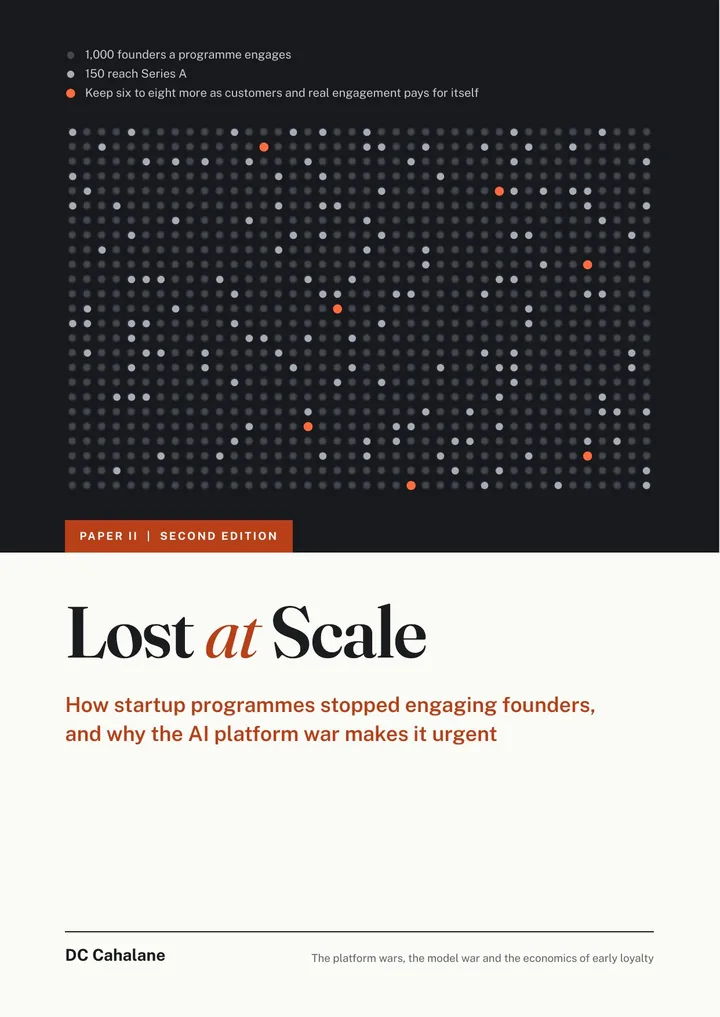 Paper II · Second edition · 97 pagesLost at ScaleHow startup programmes stopped engaging founders, and why the AI platform war makes it urgent.Learn more ›
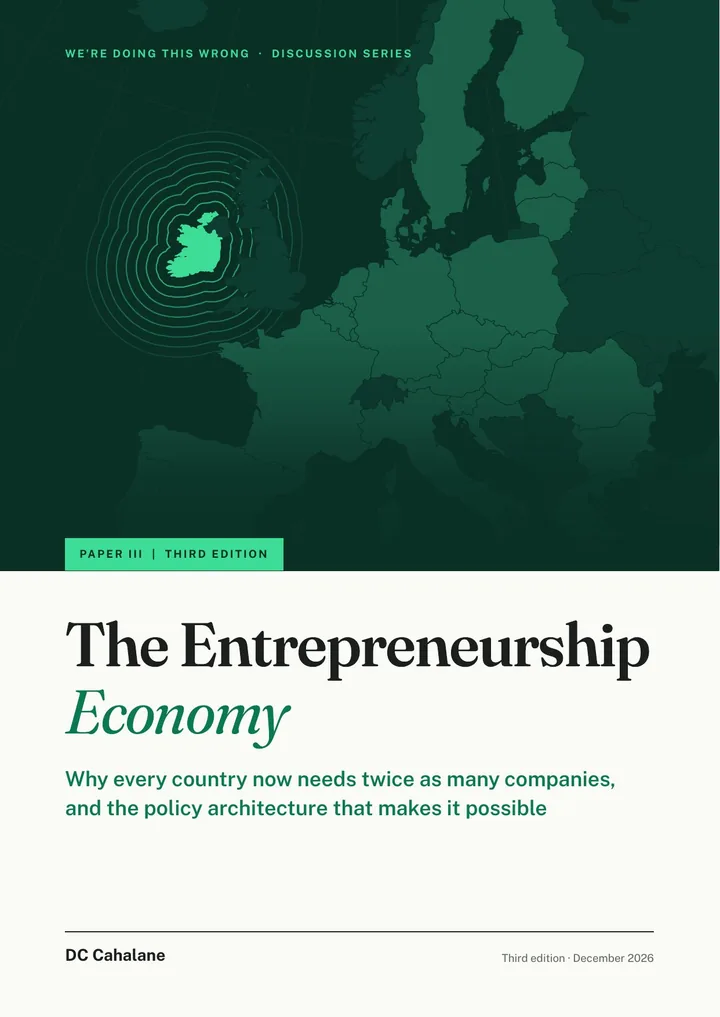 Paper III · Third edition · 151 pagesThe Entrepreneurship EconomyWhy every country now needs twice as many companies, and the policy architecture that makes it possible.Learn more ›
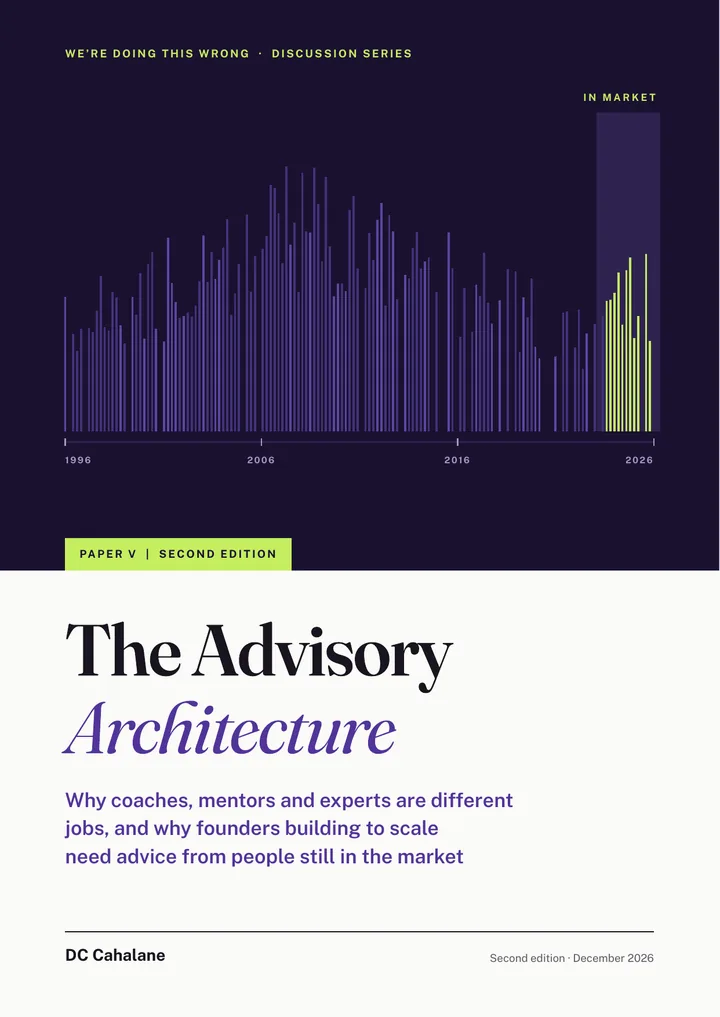 Paper V · Second edition · 64 pagesThe Advisory ArchitectureWhy coaches, mentors and experts are different jobs, and why founders building to scale need advice from people still in the market.Learn more ›
The book · March 2027
This paper is one part of a longer argument, set out in full in We’re Doing This Wrong. Join the list for the weekly essays, launch updates and each new paper as it is published.