01
The problem
Relationship-driven ecosystem contribution has drifted into portal-driven, discount-focused, quarterly-pipeline activity.
Paper II · Second edition · A discussion series for ecosystem builders
How startup programmes stopped engaging founders, and why the AI platform war makes it urgent.
The argument
They process founders through portals, hand out discounts for a place in the funnel and report the results on quarterly dashboards. Meanwhile the AI platform war has reopened the window these programmes were built for.
70 minEnd-to-end read
9Sections, with three appendices
2Composite founder stories
Summary
Most startup engagement programmes today are optimised for the wrong thing: they are measured as machines for distributing discounts, with a sales pipeline attached. They were designed as something else entirely, a way to create durable commercial value for both sides. That original model was lost, mostly at scale, as programmes grew and were absorbed into commercial organisations with commercial targets.
The cost of the drift is measurable, in churn, in brand damage, in lost intelligence and in pipeline left on the table. Founders who felt supported in their earliest days become extraordinarily loyal customers as they scale. Founders who were filtered through a portal and sold to on a webinar do not.
The paper sets out the problem, the cost and a practical framework for moving beyond the “for Startups” era.
Inside the paper
What is inside
How startup engagement programmes began, and why remembering matters now.
How defensible decisions, made one at a time over years, produced a model that looks nothing like the one it started as.
What early-stage founders need, and what most programmes are structurally unable to give them.
Why these programmes were built for platform evangelism in the first place, and why AI has put the industry back at the same starting line.
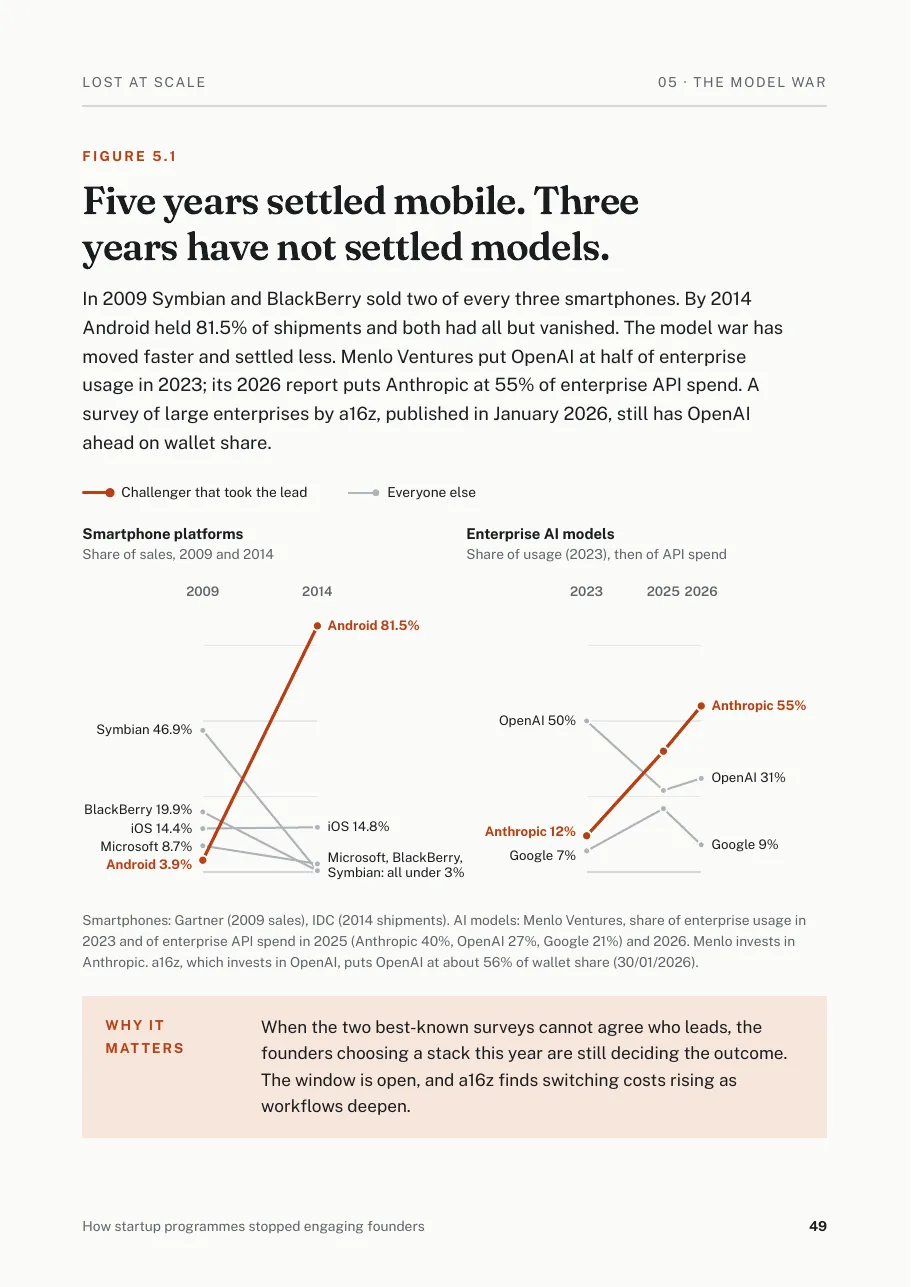
Three AI companies are competing for the prize the platform companies fought over in 2008: the founders whose first choices become tomorrow’s largest accounts.
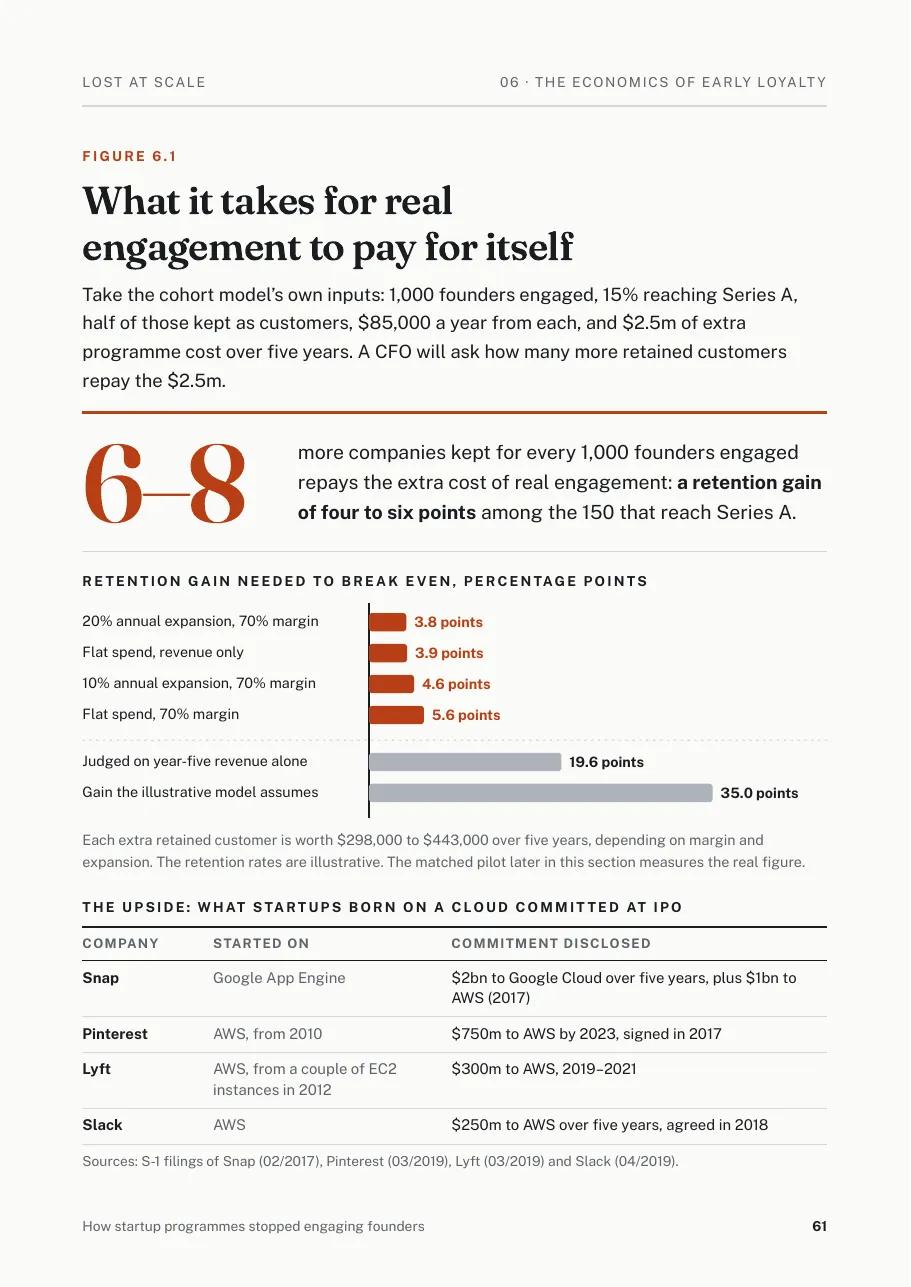
Why startups are the best customers large companies do not realise they have, and what it takes for real engagement to pay for itself.
What the dashboard does not measure, and the costs that build while no one is looking.
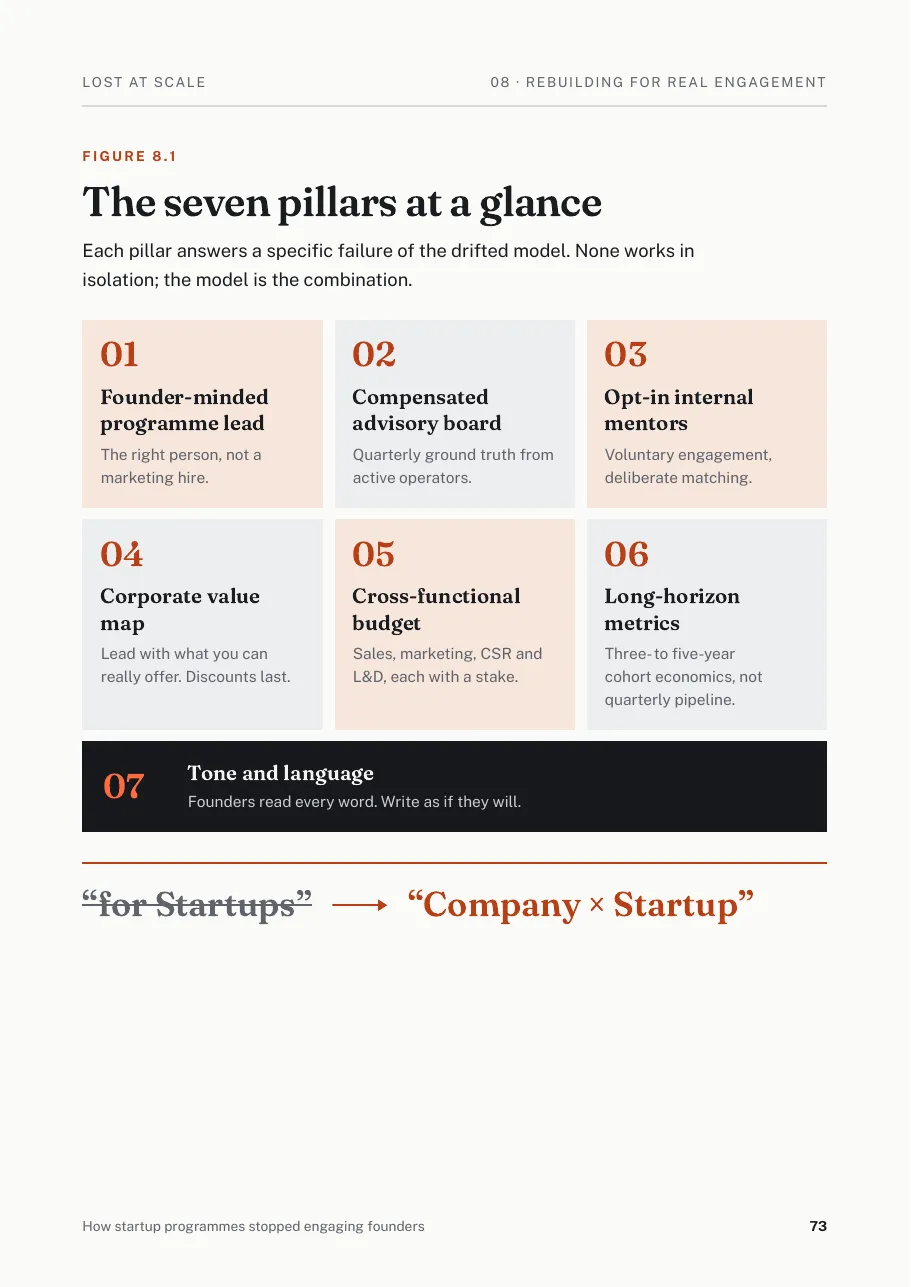
The seven-pillar framework for a programme that works, and how to start in the first twelve months.
The lasting value of real relationships, and why the window is open now.
Executive summary
01
Relationship-driven ecosystem contribution has drifted into portal-driven, discount-focused, quarterly-pipeline activity.
02
The human touch, ecosystem positioning, and the earliest window when founders choose their stack and their trusted partners.
03
Long-term customers, early market intelligence, employee learning, cultural relevance, and founder trust.
04
A rebuilt model measured over years, with founder-minded leadership, advisory input, internal mentors, and cross-functional ownership.
The rebuild
Lost at Scale proposes seven practical shifts that turn founder engagement back into a relationship system rather than a benefits catalogue.
A senior operator who understands founders, can navigate the company, and protects relationship quality.
Three to five founders or operators who act as the programme’s reality check and intelligence layer.
Employees who choose to mentor founders, with deliberate matching and a clear time commitment.
A map of genuine help across technical, sales, investor, hiring, product, and operational expertise.
Sales, marketing, corporate affairs, and learning teams each own the outcomes they actually value.
Measures that include commercial, relationship, internal, and ecosystem value over three to five years.
A shift from generic automated selling to specific, human, useful communication.
Who it is for
For leaders asking whether startup programmes create strategic advantage or simply maintain a visible innovation posture.
For teams trying to move from generic founder marketing into trusted ecosystem positioning.
For finance leaders who need a better model for measuring early loyalty, retention, and long-horizon value.
For people leaders who see mentorship and founder exposure as culture, learning, and retention infrastructure.
For the people caught between founder needs, internal politics, quarterly metrics, and an inherited portal.
Opening scene
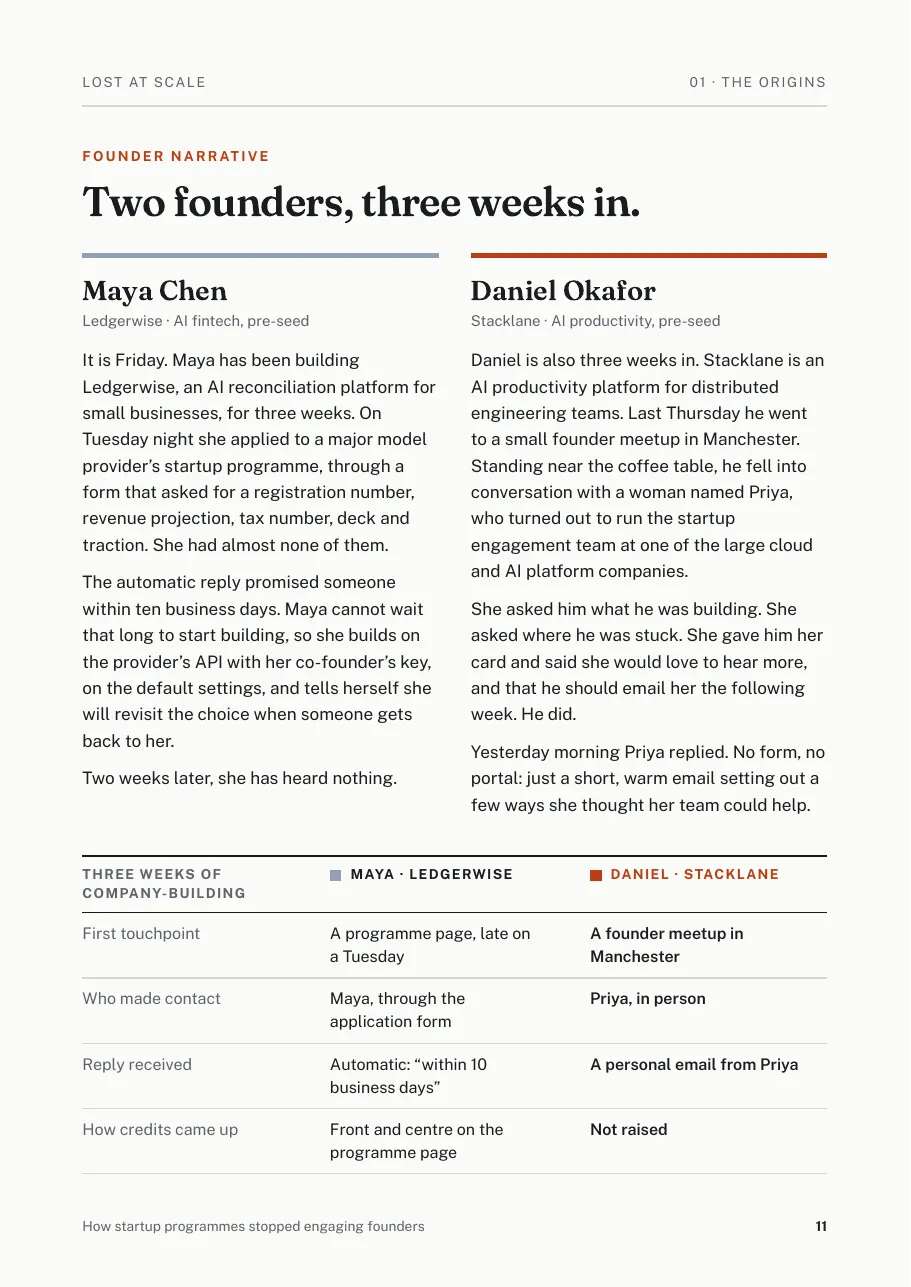
Maya is at her kitchen table. Seventeen tabs are open. She is three weeks into building her company, and she has to choose the model her product will run on by Friday.
Three of the largest AI companies have put credits on the table. The third offer comes with a form that asks for fifteen things she does not have. Two weeks later, she has heard nothing.
Download
The full paper: how the drift happened, what it costs, and the seven-pillar rebuild, with a programme health scorecard and the sources for every figure.
PDF · 3.8 MB · 97 pages. Free to read and share. No sign-up needed.
Cite this paper: DC Cahalane. Lost at Scale: How startup programmes stopped engaging founders, and why the AI platform war makes it urgent. We're Doing This Wrong discussion series, Paper II. Second edition. https://www.weredoingthiswrong.com/lost-at-scale
A discussion series for ecosystem builders
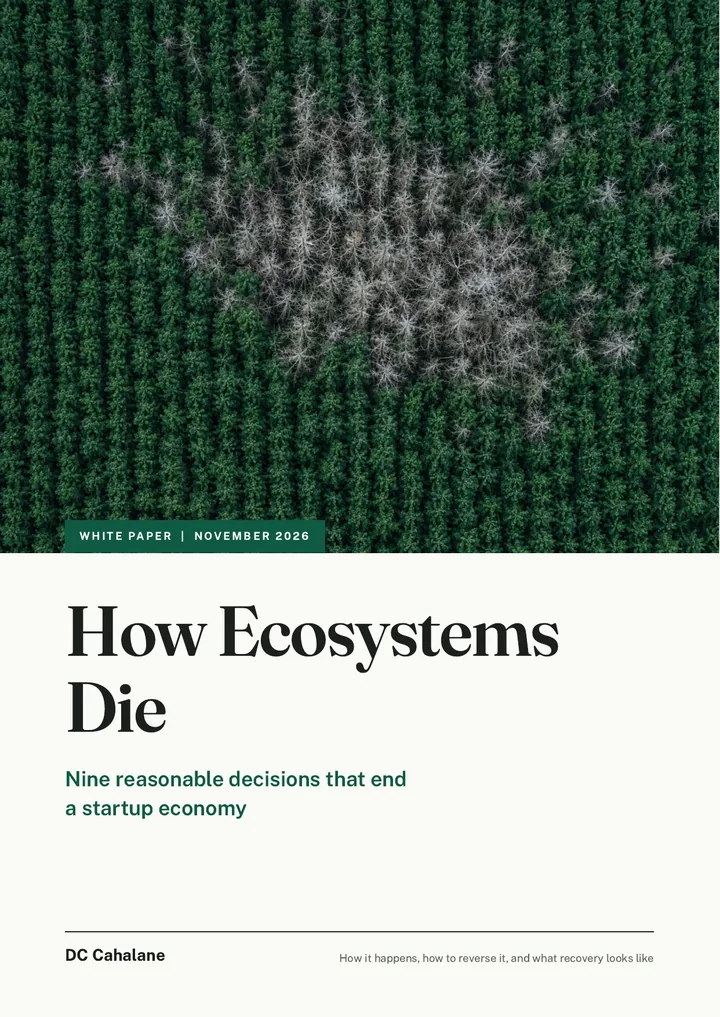 Paper I · 33 pagesHow Ecosystems DieNine reasonable decisions that end a startup economy: how it happens, how to reverse it, and what recovery looks like.Learn more ›
 Paper III · Third edition · 151 pagesThe Entrepreneurship EconomyWhy every country now needs twice as many companies, and the policy architecture that makes it possible.Learn more ›
 Paper IV · Second edition · 77 pagesThe Equity TrapWhy universities lose the companies their research creates, and what to build instead.Learn more ›
 Paper V · Second edition · 64 pagesThe Advisory ArchitectureWhy coaches, mentors and experts are different jobs, and why founders building to scale need advice from people still in the market.Learn more ›
The book · March 2027
This paper is one part of a longer argument, set out in full in We’re Doing This Wrong. Join the list for the weekly essays, launch updates and each new paper as it is published.