01
Room 01 · Governments, universities & economic development leaders
Deliberate design, not direct control.
A field guide for public institutions that want entrepreneurship policy to produce companies, not theatre. The book argues that regions do not win by running more programmes. They win when capital, customers, talent, trust, and timing are designed around the founder’s real path.
Design the conditions. Do not try to command the outcome.
This page is for you if
Activity is high. Momentum is low.
If any of these signals sound familiar, the argument that follows is written for your room: policy teams, university leaders, economic-development agencies, and civic institutions trying to turn activity into founder momentum.
02
Entrepreneurship is celebrated, but spinouts are hard to form.
03
Events, grants, and dashboards exist, but founders barely use them.
04
Talent, research, and capital are present, but the flywheel refuses to spin.
05
Funding is available, but the system still rewards theatre over traction.
06
Everyone agrees founders matter, but no one owns the founder journey.
The core argument
“The answer isn’t absence of structure. It’s deliberate design instead of direct control.”
Government and university leaders already have the assets that matter: policy authority, convening power, research intensity, talent pipelines, procurement leverage, and long time horizons. The problem is that those assets are often organised around institutional activity rather than founder velocity.
Why this matters now
Stop funding the scenery. Start building the architecture.
Most startup policy is judged by what institutions can count: applications, events, grants awarded, incubator occupancy, patents filed, and companies announced. Those indicators may be administratively useful, but they do not tell you whether founders reached the right people before critical decisions locked in.
01 · Government
Programme spend becomes infrastructure.
Use the book to connect grants, accelerators, procurement, immigration, universities, and finance into one coherent founder pathway instead of a loose collection of initiatives.
02 · Universities
Long horizons become founder advantage.
Universities are not passive pipeline feeders. They can become ecosystem architects by organising talent, research, alumni, industry relationships, and formation-stage support around company creation.
03 · Measurement
Outcomes replace startup theatre.
The book helps teams move from programme health to ecosystem health: time-to-access, founder progression, customer connection, capital readiness, talent flow, and compounding network effects.
The institutional trap
The system behaves rationally at the transaction level and irrationally at the ecosystem level.
Government wants predictability.
It reaches for detailed plans, fixed milestones, and rigid KPIs because those are legible to budget processes. Ecosystems form through feedback, timing, trust, and repeated founder decisions.
Universities want capture.
They can overvalue the percentage and undervalue the probability. Five percent of a company that exists is worth more than twenty-five percent of abandoned IP.
Founders need speed.
Institutional support often arrives months after the formation-stage decisions that determine whether a company becomes fundable, investable, and connected to the region.
AI compresses the window.
When company formation accelerates, old support models become more visibly off-cadence. Architecture matters because timing now compounds faster.
From Paper IV · The Equity Trap
Universities should take less when the company is fragile.
Universities have built large portfolios of entrepreneurship and commercialisation activity, much of it optimised for institutional legibility rather than founder outcomes. Technology-transfer offices count disclosures, patents and licences; entrepreneurship centres count events and incubator places. The founder’s experience stays slow and fragmented.
The paper proposes seven moves: publish founder-friendly terms; move technology transfer upstream to the moment a researcher first says “this might be a company”; build PhD-to-founder pathways; separate education from venture building; manage the relationship with the companies that scale; turn founder alumni into partners; and measure outcomes rather than activity.
“The university that takes less when a company is fragile creates more companies, more jobs, more research and, in the end, more institutional value.”
What to read for this audience
Part II is built for public-sector readers.
- 01
From Programs to Architecture
Why government’s highest-leverage role is not running more programmes, but designing the architecture around founders.
- 02
Architectural Principles for Officials
How officials can shift from directing activity to enabling emergence without abandoning accountability.
- 03
Universities as Ecosystem Architects
Why the institutions with the longest time horizons can become the fastest-compounding infrastructure in the ecosystem.
- 04
Designing Formation-Stage Infrastructure
The four-layer model: pipeline development, resource coordination, decision support, and early intervention.
- 05
Measuring Architectural Success
How to measure whether founders are moving faster, with better information, stronger relationships, and lower friction.
Use the book to redesign
Four public-institution decisions that shape the ecosystem.
01
Grant architecture
Shorten decision cycles, remove founder-time waste, and connect funding to customer discovery, talent, and follow-on capital.
02
University spinouts
Simplify terms, reduce negotiation drag, and design technology transfer around company formation rather than institutional extraction.
03
Procurement & demand
Move beyond showcases by making the public sector and anchor institutions credible early customers where appropriate.
04
Regional flywheels
Turn alumni, repeat founders, technical talent, specialist investors, and corporate customers into compounding ecosystem infrastructure.
What readers take away
A practical operating model for serious rooms.
A policy lens
See when government should set conditions rather than control activity.
A university lens
Rebuild the relationship between research, enterprise, founders, and alumni.
A measurement lens
Replace vanity metrics with leading indicators of ecosystem health.
An implementation lens
Protect architecture from budget cycles, political incentives, and programme drift.
White papers
Free to read.
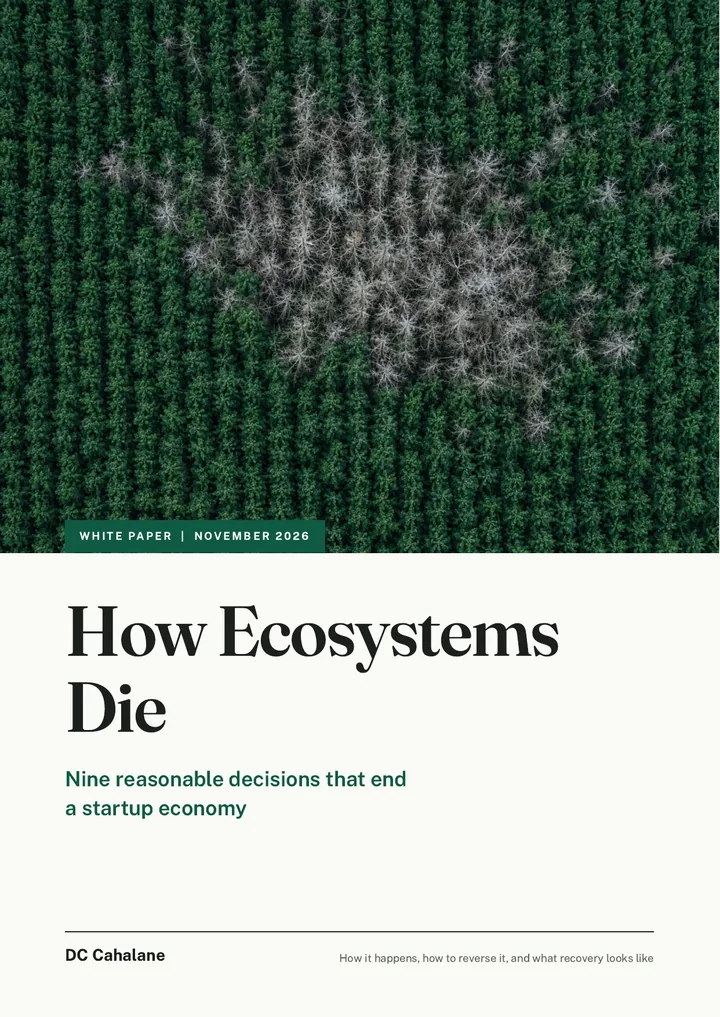 Paper I · 33 pagesHow Ecosystems DieNine reasonable decisions that end a startup economy: how it happens, how to reverse it, and what recovery looks like.Learn more ›
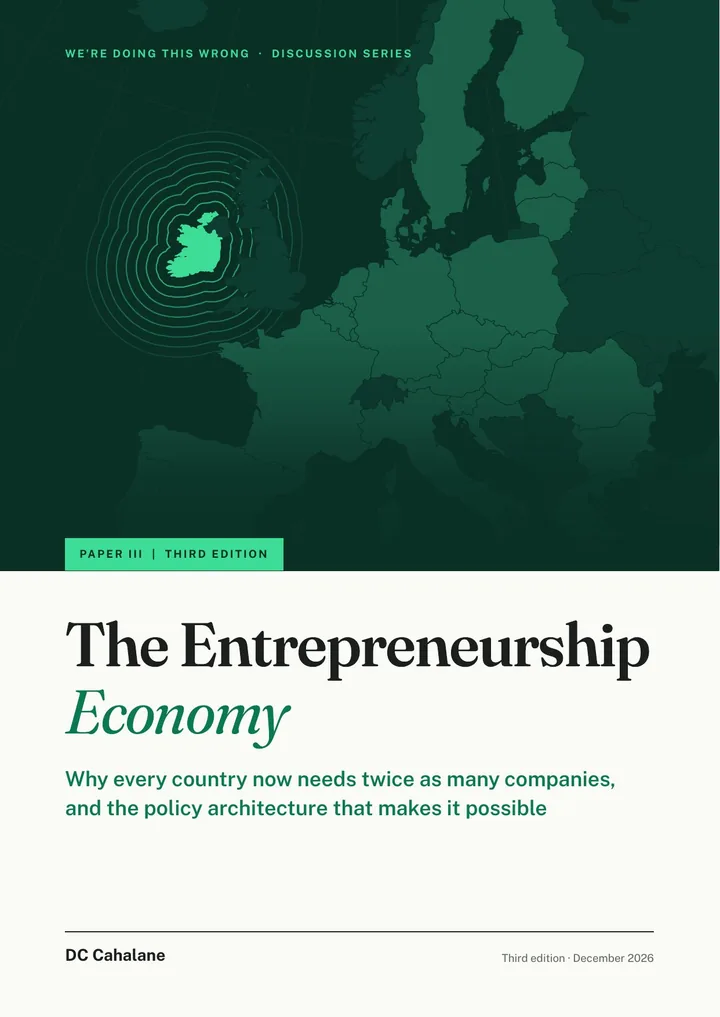 Paper III · Third edition · 151 pagesThe Entrepreneurship EconomyWhy every country now needs twice as many companies, and the policy architecture that makes it possible.Learn more ›
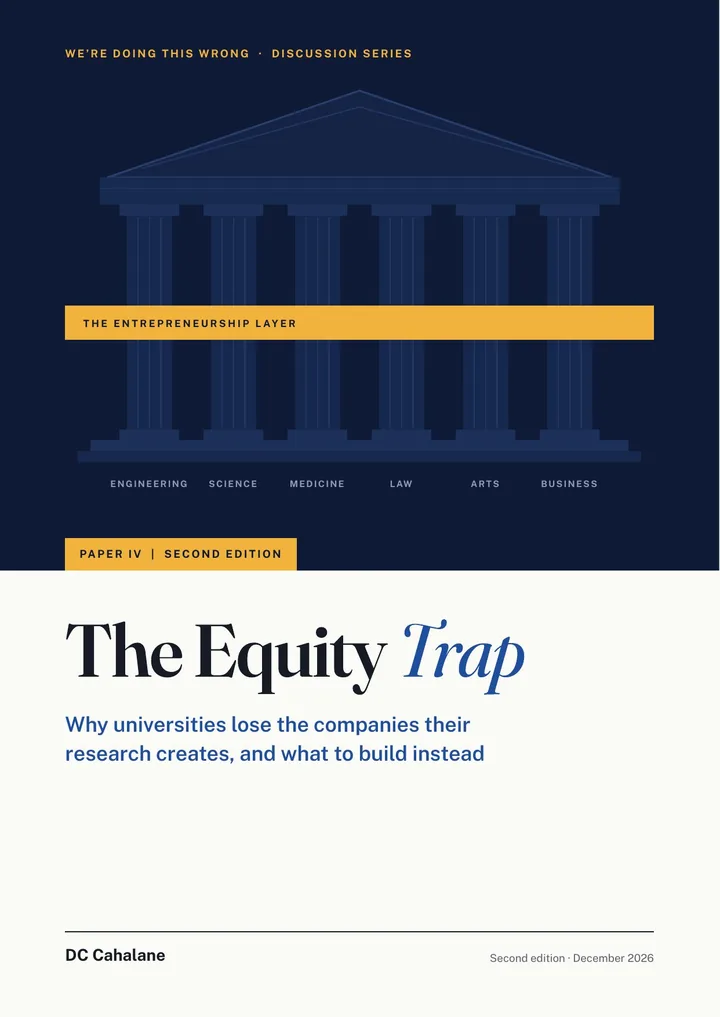 Paper IV · Second edition · 77 pagesThe Equity TrapWhy universities lose the companies their research creates, and what to build instead.Learn more ›
For policy teams, university leaders, and economic development agencies