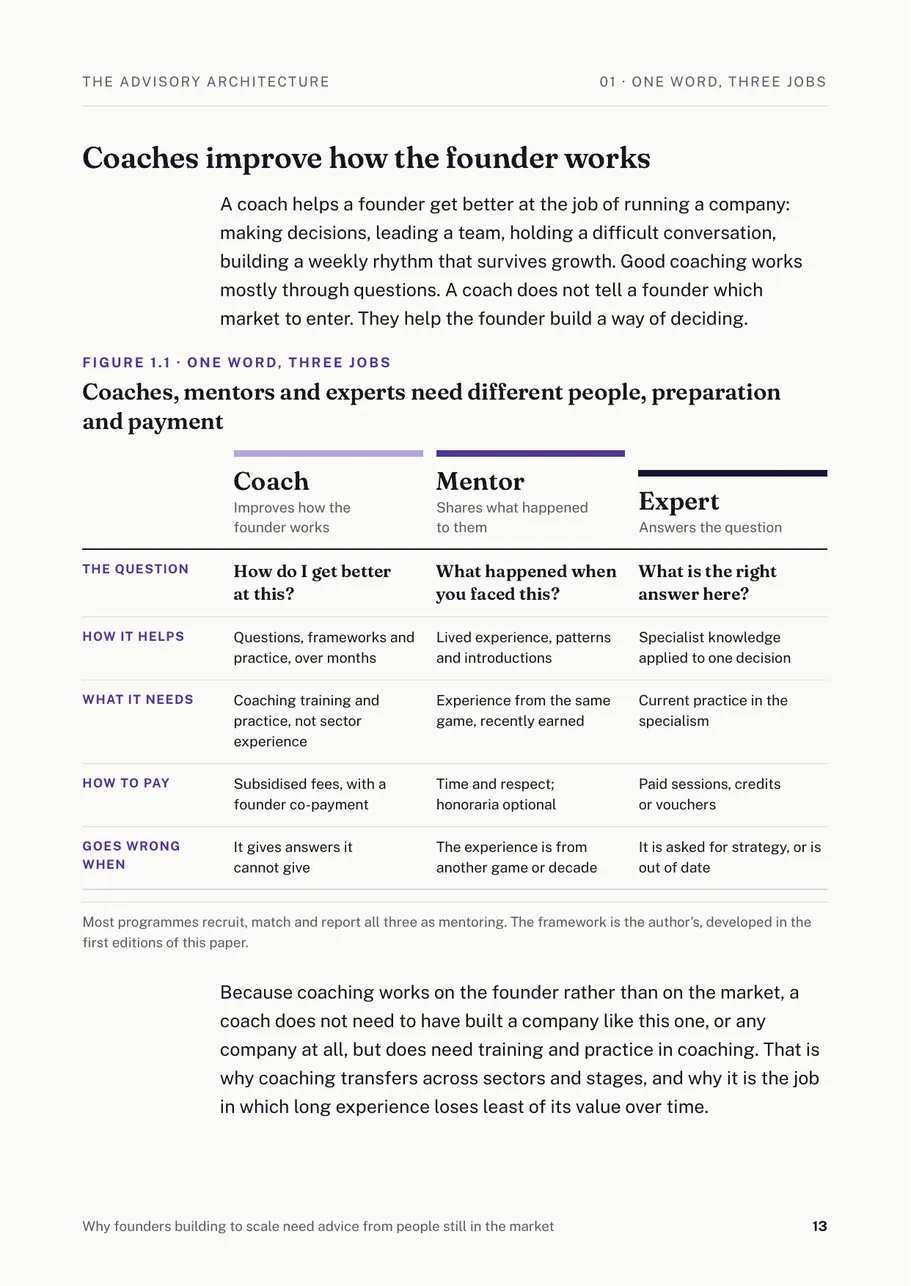
Coach
A coach helps a founder get better at running the company and does not need to know the market.
Paper V · Second edition · A discussion series for ecosystem builders
Why coaches, mentors and experts are different jobs, and why founders building to scale need advice from people still in the market.
The argument
Coaches, mentors and experts do three different jobs. Advice for a company built to scale often contradicts advice for one built to last. And much of what a scaling founder needs to know decays within a year or two. This paper sets out three tests for every adviser, and an architecture that routes founders’ decisions to people still in the market.
8Sections in two parts: the diagnosis and the rebuild
3Tests for every adviser: which job, which game, and how recently
5Questions on the founder’s routing card, answered before any match
Summary
Every ecosystem has mentors, and most have hundreds. Programmes report the size of their networks and the hours given. Almost none can say which kind of help each founder needed, whether the person they met could give it, or whether any decision changed.
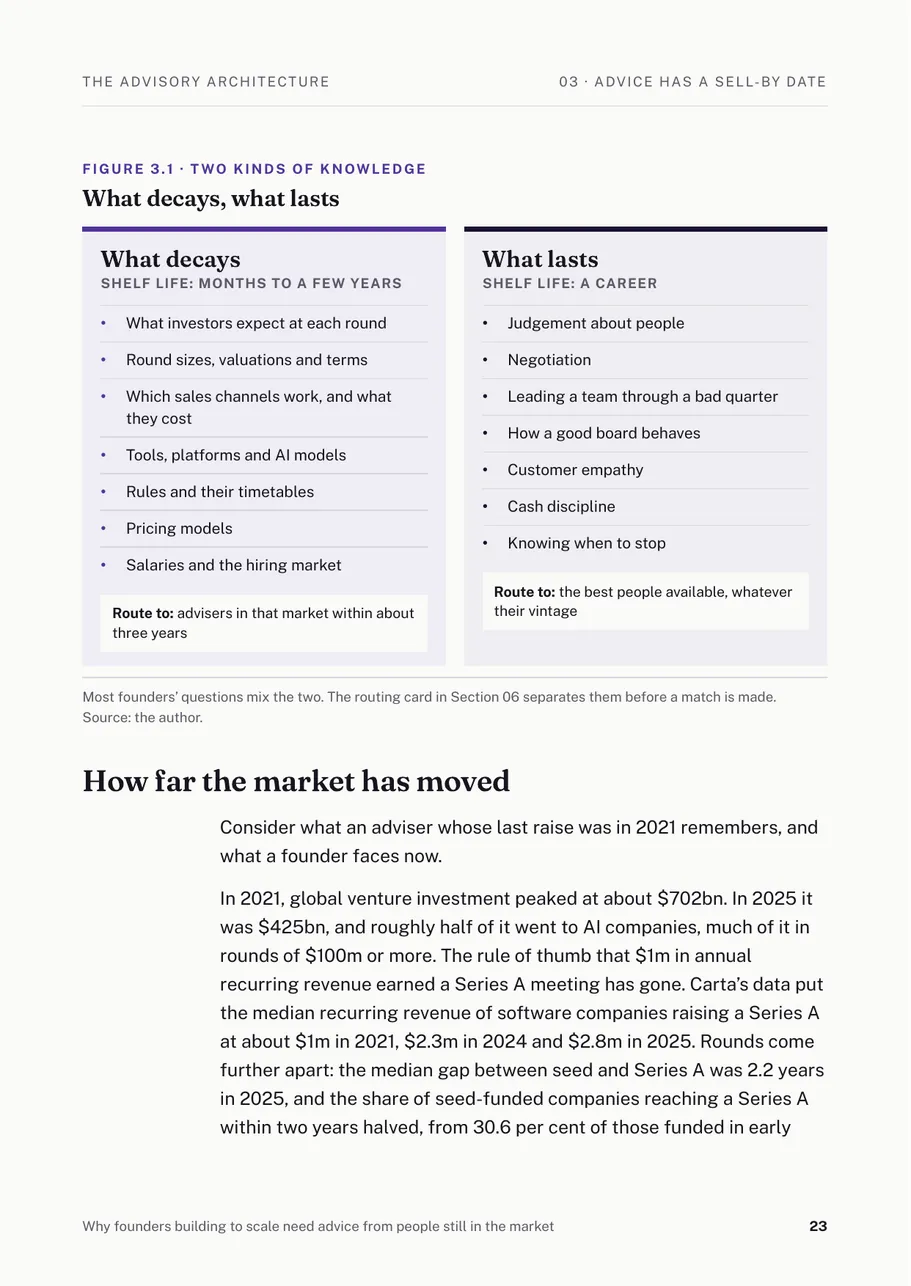
A coach helps a founder get better at running the company and does not need to know the market. A mentor shares what happened when they faced the same problem. An expert answers a specific question with specialist knowledge. Each is valuable, and each fails when asked to do one of the others.
Inside the paper
What is inside
Why coaches, mentors and experts are different kinds of help, and what it costs when an ecosystem calls them all mentoring.
Why advice for a company built to last and advice for a company built to scale so often point in opposite directions, and why both can be right.
Why much of what a scaling founder needs to know decays within a year or two, and why the best source is usually someone still in the market.
Why advisers shape an ecosystem as well as its companies, and how one bench’s blind spots become everyone’s norms.
Field experiments and studies on who gives advice, of what kind and with what structure, and what they imply for design.
The advisory architecture: label every adviser by job, game and clock, and route each founder’s decision to the right one.
Where in-market advisers are found, how to ask them, how to pay each kind of adviser and how to keep the bench current.
Matching within days, decision windows, a lead adviser to weigh the rest, and measures that count decisions and outcomes rather than hours.
One word, three jobs
Each is valuable, and each fails when asked to do one of the others.
A coach helps a founder get better at running the company and does not need to know the market.
A mentor shares what happened when they faced the same problem.
An expert answers a specific question with specialist knowledge.
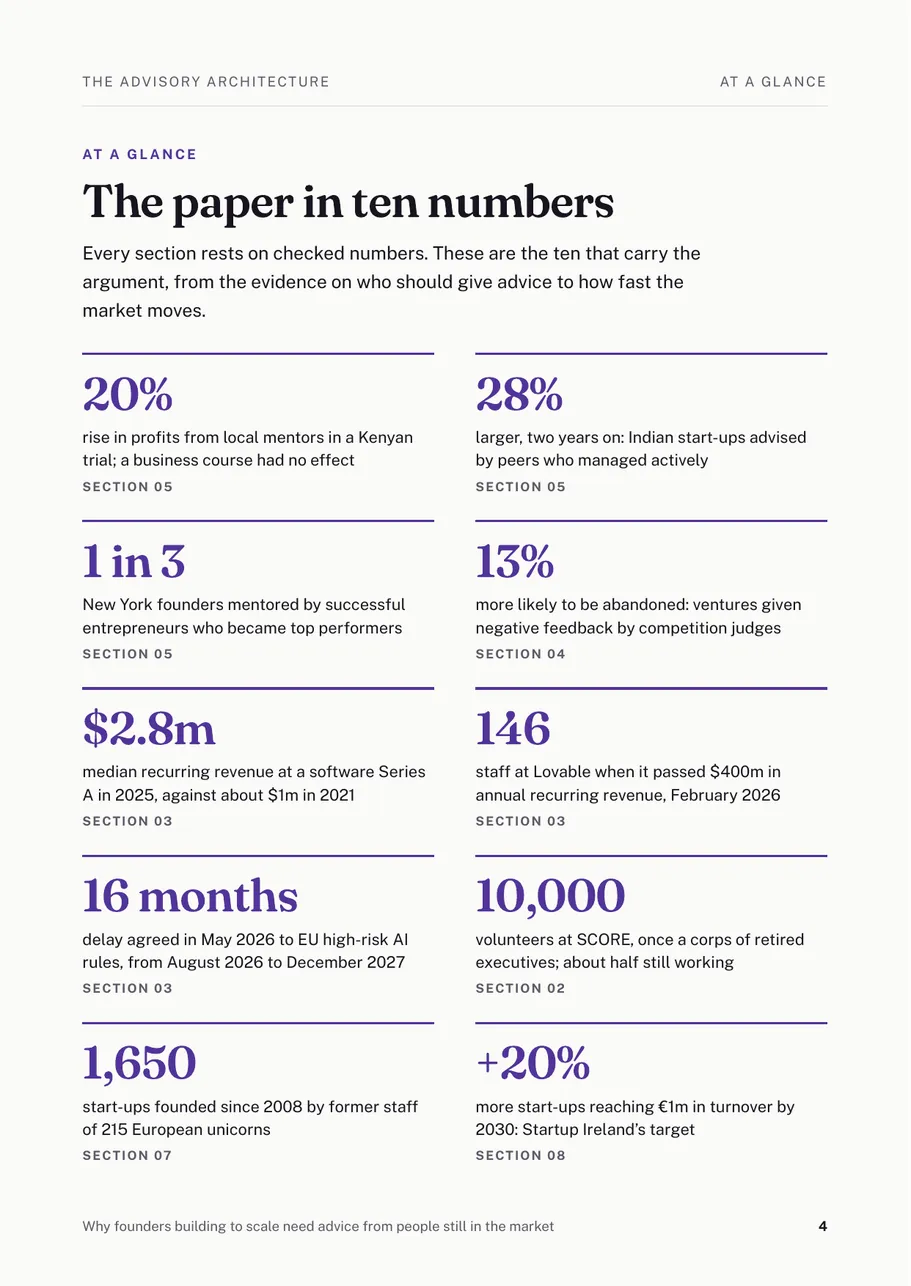
At a glance
Every section rests on checked numbers. These are the ten that carry the argument, from the evidence on who should give advice to how fast the market moves. The source for each is given in the section named.
20%
rise in profits from local mentors in a Kenyan trial; a business course had no effect
Section 05
28%
larger, two years on: Indian start-ups advised by peers who managed actively
Section 05
1 in 3
New York founders mentored by successful entrepreneurs who became top performers
Section 05
13%
more likely to be abandoned: ventures given negative feedback by competition judges
Section 04
$2.8m
median recurring revenue at a software Series A in 2025, against about $1m in 2021
Section 03
146
staff at Lovable when it passed $400m in annual recurring revenue, February 2026
Section 03
16 months
delay agreed in May 2026 to EU high-risk AI rules, from August 2026 to December 2027
Section 03
10,000
volunteers at SCORE, once a corps of retired executives; about half still working
Section 02
1,650
start-ups founded since 2008 by former staff of 215 European unicorns
Section 07
+20%
more start-ups reaching €1m in turnover by 2030: Startup Ireland’s target
Section 08
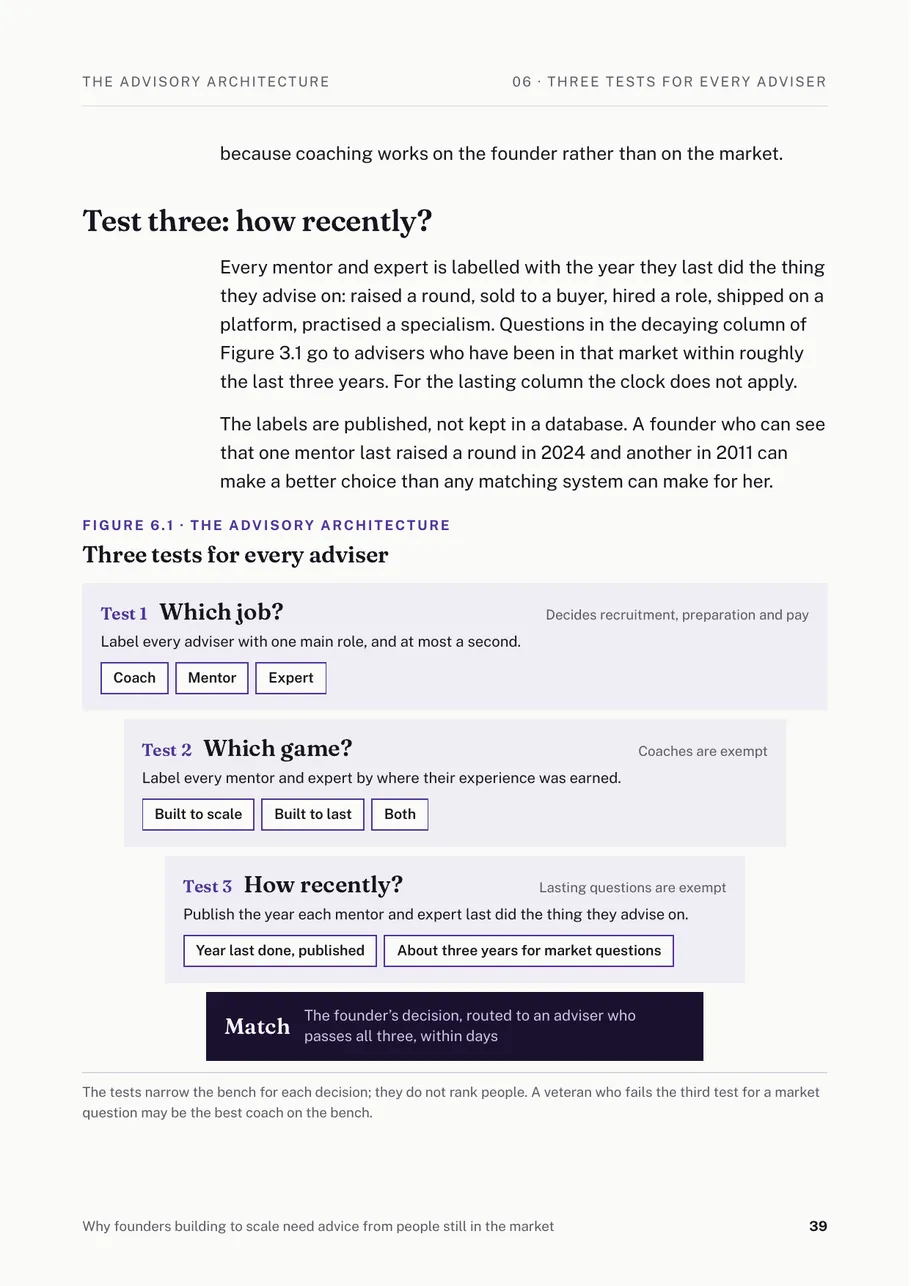
The advisory architecture
A small number of rules that decide who advises whom, on what, and how the result is recorded.
Every adviser is labelled by the job they do, coach, mentor or expert, with one main role and at most a second. The label decides how they are recruited, prepared, matched and paid.
Every mentor and expert is labelled by the kind of company their experience comes from: built to scale, built to last, or both. Coaches are exempt, because coaching works on the founder rather than on the market.
Every mentor and expert is labelled with the year they last did the thing they advise on: raised a round, sold to a buyer, hired a role, shipped on a platform, practised a specialism.
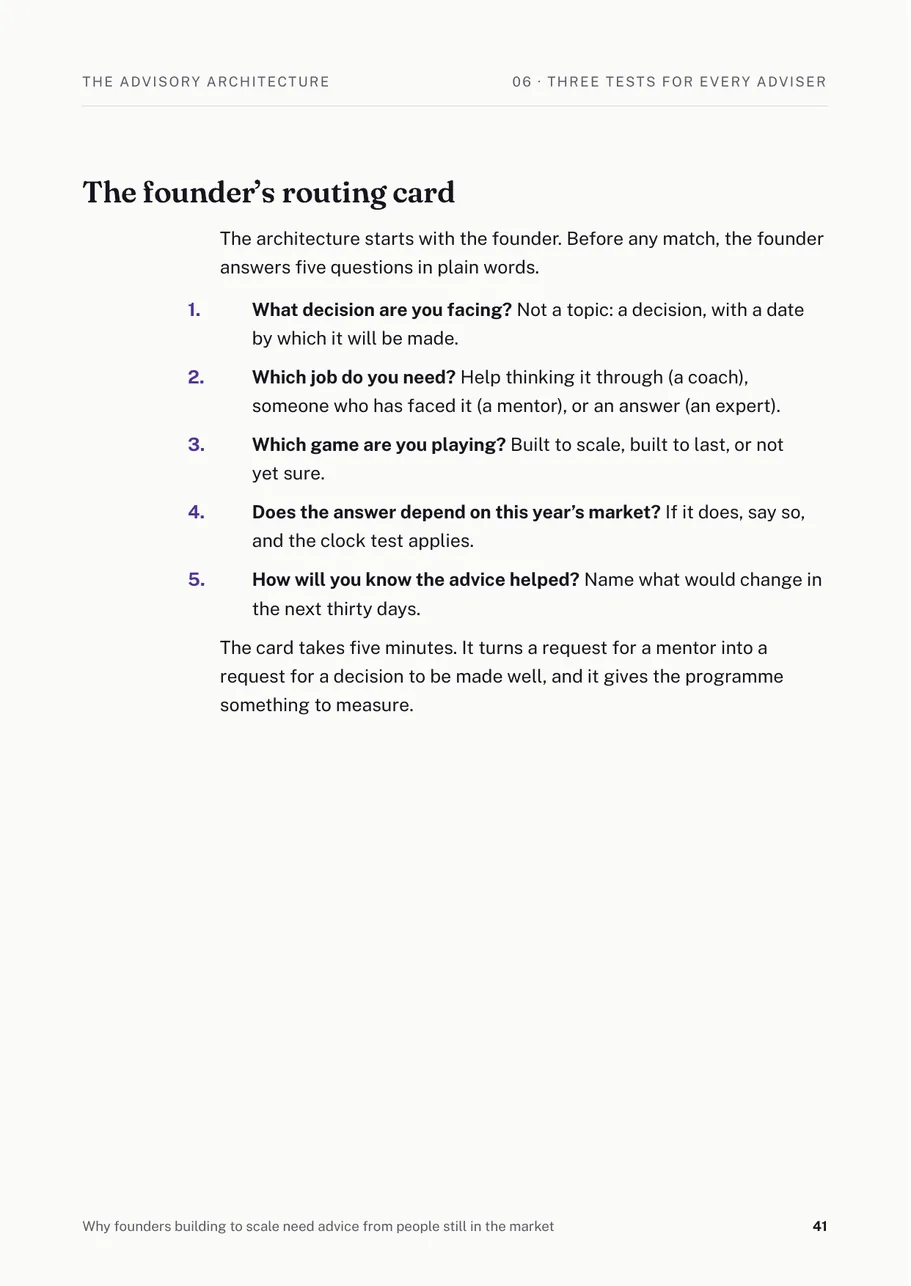
The founder’s routing card
The architecture starts with the founder. The card takes five minutes. It turns a request for a mentor into a request for a decision to be made well, and it gives the programme something to measure.
Not a topic: a decision, with a date by which it will be made.
Help thinking it through (a coach), someone who has faced it (a mentor), or an answer (an expert).
Built to scale, built to last, or not yet sure.
If it does, say so, and the clock test applies.
Name what would change in the next thirty days.
How to use this paper
Ministers and their departments, enterprise agencies, accelerator and incubator managers, universities, corporate startup programmes and investors. It is also for founders, and for the many people who give their time as mentors.
The executive summary, Sections 04 and 06, and one country’s version.
Sections 02, 06 and 08, and where this lands.
Sections 01, 07 and 08 in full.
Sections 01 to 03, then the routing card in Section 06.
Sections 01 and 03, then the adviser’s self-test in Section 07.
From the paper
The question is never whether an adviser has experience. It is which experience, and how recent.
The right job, from the right game, from someone still in the market.
Download
The full second edition: the three jobs, the two games, the three tests, the founder’s routing card, and Ireland worked through as one country’s version.
PDF · 3.4 MB · 64 pages. Free to read and share. No sign-up needed.
Cite this paper: DC Cahalane. The Advisory Architecture: Why coaches, mentors and experts are different jobs, and why founders building to scale need advice from people still in the market. We're Doing This Wrong discussion series, Paper V. Second edition. December 2026. https://www.weredoingthiswrong.com/the-advisory-architecture
A discussion series for ecosystem builders
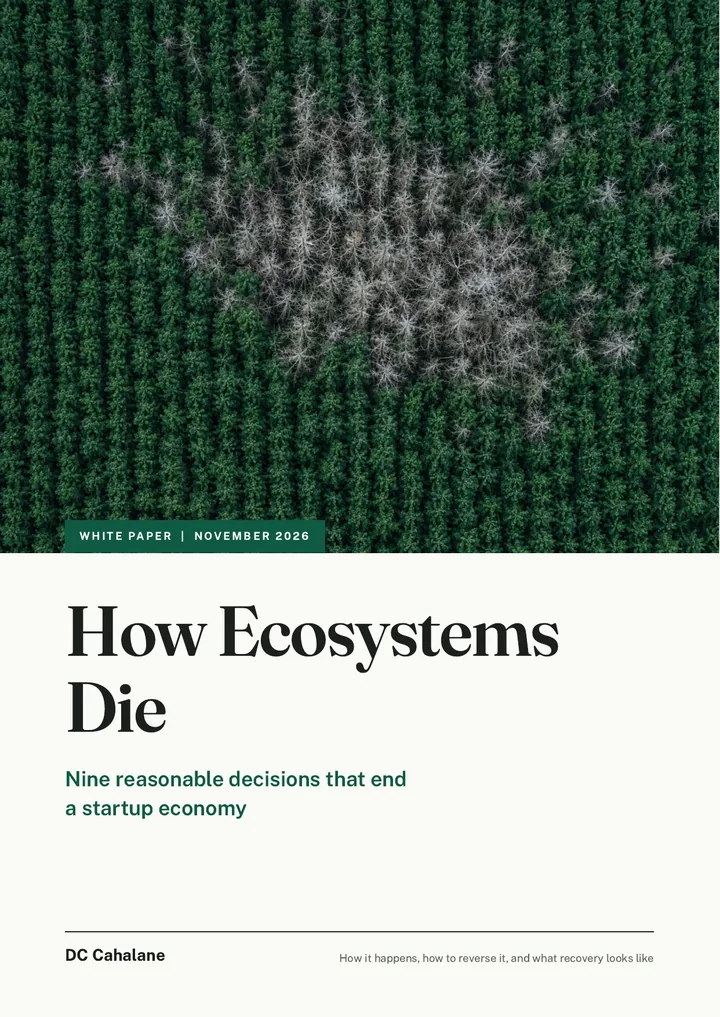 Paper I · 33 pagesHow Ecosystems DieNine reasonable decisions that end a startup economy: how it happens, how to reverse it, and what recovery looks like.Learn more ›
 Paper II · Second edition · 97 pagesLost at ScaleHow startup programmes stopped engaging founders, and why the AI platform war makes it urgent.Learn more ›
 Paper III · Third edition · 151 pagesThe Entrepreneurship EconomyWhy every country now needs twice as many companies, and the policy architecture that makes it possible.Learn more ›
 Paper IV · Second edition · 77 pagesThe Equity TrapWhy universities lose the companies their research creates, and what to build instead.Learn more ›
The book · March 2027
This paper is one part of a longer argument, set out in full in We’re Doing This Wrong. Join the list for the weekly essays, launch updates and each new paper as it is published.